Machiavelli’s The Prince Deeper Elucidation (Part-9) | Secrets of Power & Leadership |


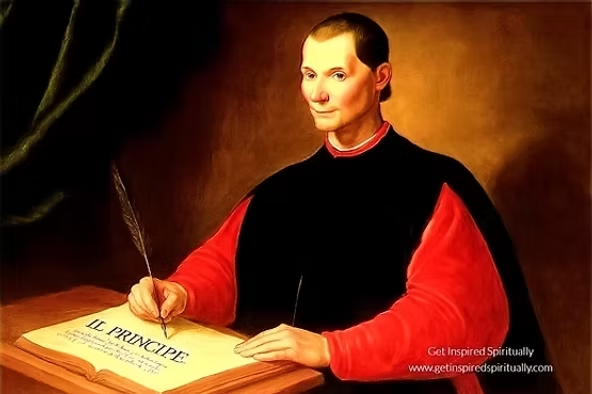
Power. Deception. Survival. In 1513, Niccolò Machiavelli wrote a book that shattered illusions and exposed the raw mechanics of leadership: The Prince. This was no idealistic vision—it was a ruthless manual for rulers on how to win, hold, and wield authority, even if it meant bending morality itself. Centuries later, it still stands as one of the most controversial and provocative guides to power ever written. This post covers Chapter 8: States won by crime.
We publish book summaries on political philosophy and leadership because understanding these topics is crucial for obtaining power. Competent leaders must gain power to prevent uninformed individuals from causing harm. Spirituality is also about making the world, a better place to live.
Overview of the Last Post:
Gaining power through luck or external backing can be quite thrilling, but it comes with its own set of challenges when it comes to holding onto it! Those who rise swiftly, much like some of the Ionian and Hellespontine leaders appointed by Darius, often find themselves without the essential skills and dependable allies needed to sustain their rule. Similarly, emperors who rise by bribing the military depend on unstable backing, making them vulnerable to collapse.
A ruler who gains power unexpectedly must possess extraordinary talent or rely on luck. Francesco Sforza exemplifies success through ability, rising from commoner to Duke of Milan, while Cesare Borgia, despite his strategic efforts, lost power due to misfortune after his father's death. Borgia's groundwork, however, remains valuable guidance for new rulers. His strategies, though ultimately undone by circumstances, showcased remarkable ambition and foundational strength.
Pope Alexander VI faced significant challenges in establishing his son, Cesare Borgia, as a ruler due to opposition from the Duke of Milan and the Venetians, who protected Faenza and Rimini. The Italian armies, led by the Orsini and Colonna families, were wary of papal expansion and proved to be unreliable allies. To counter this, Alexander leveraged the Venetians' desire to bring the French back to Italy, facilitating King Louis's strategic entry by annulling his first marriage. Louis's capture of Milan enabled him to support Cesare in conquering Romagna, a feat impossible without French aid.
Cesare Borgia, the most notable illegitimate son of Alexander VI, was a central figure of the Italian Renaissance, known for his political and military prowess. He faced challenges in maintaining Romagna and expanding his territory, particularly concerning the loyalty of his army and the French policy. Despite capturing Faenza and Urbino, Cesare's reliance on the Orsini family was fraught with uncertainty. To secure his position, he weakened the Orsini and Colonna factions by enticing their supporters with high salaries and strategic appointments.
In a swift maneuver, Cesare dismantled the Colonna leaders and awaited the right moment to target the Orsini. When the Orsini realized the threat of Cesare's power, they rebelled, but with French support, Cesare regained his standing. Using cunning, he deceived the Orsini into making peace, ultimately eliminating their leaders and consolidating his control over Romagna and the Duchy of Urbino. By enforcing effective governance, Cesare restored order and respect for authority, gaining local support through prosperity.
Ramiro de Orco, a ruthless Spanish condottiero, was appointed to unify the region, but his harsh governance prompted the duke to establish a civil court and execute de Orco to pacify the populace. Borgia, having consolidated power, built an army to counter threats and sought alliances to secure his position against a potentially hostile papal successor. He implemented strategies to remove local rulers, gain Roman nobility support, influence the College of Cardinals, and expand his territory. Despite setbacks following his father's death, Borgia's strategic foundations remained strong, though he failed to prevent his adversary Giuliano della Rovere from becoming Pope Julius II. Borgia's ambition and strategic foresight highlight the importance of envisioning systems that bolster dominance, even if mistakes occur along the way.
Chapter 8: States won by crime

Beyond fortunate circumstances and inherent qualities, there are two other routes for a private citizen to become a ruler: seizing power through a heinous crime or becoming a hereditary ruler with citizen support. Focusing on the former, we explore two historical examples. Agathocles of Syracuse, born a potter's son and living a life marked by depravity, rose from obscurity to command the Syracusan army. With exceptional skills, he aimed for kingship, employing necessary violence to maintain power independently. Aligning with Hamilcar, a Carthaginian leader in Sicily, Agathocles convened an assembly under the guise of state matters to further his ambitions.
Agathocles, having orchestrated a massacre of senators and wealthy citizens, ascended to the throne of Syracuse unopposed. Despite facing defeats and a siege by the Carthaginians, he successfully defended Syracuse and even launched a counterattack on Africa, leading to a treaty that left Sicily to him. His rise to power, marked by risk-taking and resilience, was not due to luck or assistance but through ruthless and brutal methods that, while effective, lacked glory.
Similarly, Oliverotto of Fermo, orphaned young and raised by his uncle Giovanni Fogliani, sought power by exploiting connections and betraying trust, ultimately aiming to seize control of Fermo. Giovanni Fogliani, who had him join the army under Paulo Vitelli in the hope that, with military discipline, he would rise to a high rank. On Paulo’s death, Oliverotto served under his brother, Vitellozzo, and being very capable, with a strong personality and powerful physique, he soon became the army’s top man. But since he felt that working with others was demeaning, he decided to take Fermo for himself. Having got the support of some of the town’s citizens, people who preferred to see their city enslaved rather than free, and with the backing of Vitellozzo. He wrote to Giovanni Fogliani saying that now so many years had gone by he was eager to come home and see his uncle again, visit the town, and check over some of his property.
[Note: Oliverotto of Fermo (born Oliverotto Euffreducci), a notorious Italian condottiero (mercenary captain) and ruler of the city of Fermo, who lived from 1475 to December 31, 1502.]

Giovanni spared no effort to honor his nephew, Oliverotto, who, after being formally received by Fermo's citizens, was welcomed into Giovanni's home. Days later, Oliverotto, having secretly plotted a crime, hosted a grand banquet for Giovanni and the town's elite. Post-dinner, Oliverotto cunningly steered the conversation towards Pope Alexander and Cesare Borgia's power, then suggested further discussion in private. Once secluded, Oliverotto's soldiers ambushed and killed the guests. He then seized control of Fermo, establishing himself as ruler by eliminating opposition and forming a new army and government. His power grew, threatening nearby towns, until he was deceived by Cesare Borgia and strangled a year after his uncle's murder, alongside his mentor, Vitellozzo Vitelli.
Both figures exemplify the pursuit of power through cunning and cruelty rather than honor or virtue. Agathocles and others like him managed to maintain their power despite their betrayals and cruelties due to their strategic use of cruelty. The key lies in whether cruelty is applied well or poorly. Well-used cruelty is swift and decisive, employed just enough to secure power and then ceased, allowing leaders to use their gained power to benefit their subjects. In contrast, poorly used cruelty is insufficient at the start and escalates over time, leading to failure. Leaders who adopt the former approach, like Agathocles, can strengthen their position both with their subjects and divinely, while the latter approach offers no such opportunity.
When taking control of a state, it is crucial to assess the necessary level of violence and cruelty and execute it swiftly to avoid continuous brutality. Once violence ceases, subjects will feel reassured, allowing you to win them over with generosity. Failing to act decisively at the start will result in ongoing violence, eroding trust and making subjects unreliable. Quick, decisive action minimizes resentment, while favors should be dispensed gradually for maximum appreciation. A ruler must maintain a consistent approach with subjects, as delayed cruelty or forced concessions will neither impress nor secure loyalty.
In statecraft, violence must be strategic and calculated to truly yield the rewards of power and control!
Get ready for an exciting journey as we dive into Chapter 9: Monarchy with Public Support! This chapter delves into aristocratic systems built on the solid foundation of public support. Discover the thrilling strategies to rise as a monarch by winning the trust and backing of the people. Stay tuned for an exhilarating exploration!
Tell us what you feel about this! Please like, share & subscribe to our site!
Thank you so much!
Yadu,
On behalf of Get Inspired Spiritually.
#Diplomacy #Statecraft #PopeAlexanderVI #Papacy #Politics #Hegemony #Oliverotto #Giovanni #Sovereignty #PoltiicalSystems #States #Crime #EffectiveGovernance #Government #Philosophy #CesareBorgia #StrategicManeuvers #Luck #Cirmumstances


Comments