Deeper Elucidations of Vidura Neeti Part-10 | #mahabharata #sanathanadharma


The Mahabharata has been called the Panchama Veda—the Fifth Veda—because it gathers the essence of the Vedas into story. Beyond its legendary battles and timeless characters, it offers insights into science, statecraft, psychology, and the human condition itself. It is a mirror of life, reflecting both our struggles and our search for wisdom.
In this post, we explore 'The Supreme Virtue: Forgiveness as the Heart of Dharma,' highlighting the crucial role and magnificence of forgiveness within the framework of Dharma (righteousness). We then move forward with 'The Luminous Strength of Forgiveness and Inner Mastery,' where Vidura underscores the crucial role of forgiveness as the cornerstone of peace of mind and tackles the six perils of humanity (Arishatvarga), as reinforced by the Bhagavad Gita.
Overview of the Last Post:
Dhritarashtra sat engulfed in darkness, while Vidura's voice, full of gentle truth, resonated with caution. Vidura warned of three acts that destroy virtue and tarnish one's legacy: theft, seduction, and betrayal. These sins erode honor, leaving a man adrift and vulnerable. Theft betrays trust and incites vengeance, while seduction devastates families and communities. The Bhagavad Gita identifies lust as a primary adversary, offering regulation and divine love as solutions. Betraying a friend undermines the principles of loyalty and companionship. These acts strip a man of integrity, leaving him with shame and regret.
Vidura questioned Duryodhana's actions, highlighting his moral decay and ambition that led to turmoil. Dhritarashtra was troubled, unable to speak. Vidura emphasized the wisdom of leadership, balancing justice, Dharma, and forgiveness. A wise king nurtures his realm with righteousness, justice, and wisdom, while a foolish king allows decay. Forgiveness, often seen as weakness, is a profound strength, paving the way for healing and reconciliation.
Vidura urged Dhritarashtra to embrace forgiveness as a tool of strength. True forgiveness is an act of courage, rising above vengeance. It is a force greater than any weapon, building bridges where swords create ruins. Forgiveness liberates one from bitterness, fostering personal growth and emotional freedom. Vidura highlighted the power of forgiveness over violence, law, and compassion, urging Dhritarashtra to teach his son its true strength. True greatness lies in restraint and compassion, not conquest and cruelty.
The Story Continues....

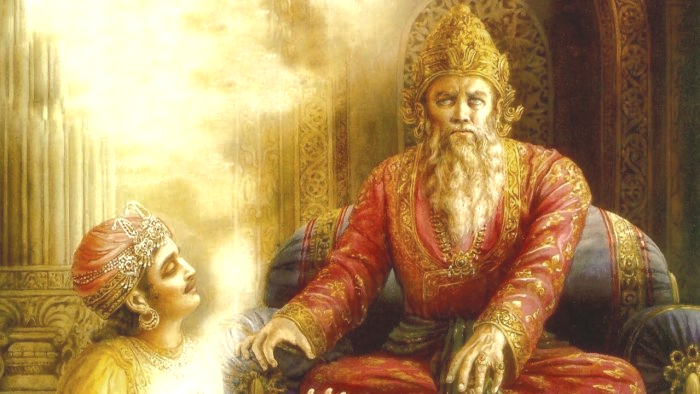
The light in the chamber settled into a soft, steady glow, casting a gentle warmth over the cold stones of Hastinapura’s palace. Vidura stood with the unwavering presence of a rishi, untouched by the allure of courtly illusion, his voice serving as both a guiding lamp and a reflective mirror.
The Supreme Virtue: Forgiveness as the Heart of Dharma

"O King," Vidura began, his words flowing like a calm stream under moonlight, "Dharma—righteousness—is the highest of all pursuits, greater than any wealth or glory that one might accumulate in this transient life. It is a path that leads to the ultimate truth and fulfillment of one’s existence. And within the vast realm of Dharma, forgiveness stands as its purest form, a radiant jewel that shines brightly against the backdrop of human frailty. It is the mother of peace, nurturing the seeds of harmony in the hearts of men, and serves as the vital link between wisdom and compassion. Knowledge can indeed bring a sense of satisfaction; non-violence can lead to fleeting joy—but it is forgiveness that makes these virtues endure and flourish, allowing them to transcend the trials and tribulations of life.
"Reflect upon this, O King: there are only two who dwell above even the heavens—one is the mighty who chooses to forgive when he has the power to punish, exhibiting strength of character that is rare among mortals; the other is a poor man who still gives, though he has nothing to spare, embodying the spirit of generosity that knows no bounds. Tell me, who among them trembles in fear? Who among them requires guards or false praises from flatterers to validate their existence?" Though Dhritarashtra remained silent, Vidura knew that the silence was beginning to listen, as if the very walls of the chamber were absorbing the weight of his words.
"For the strong, O King, there is no greater adornment than forgiveness. It is a crown that does not tarnish, a treasure that cannot be stolen. There is no place, no time, no condition where it is not proper or fitting to practice this noble act. Whether in courtly decisions that shape the fate of kingdoms or in the heat of battle where lives hang in the balance, whether in speech that can uplift or in restraint that can heal—if one can truly forgive, he wields a power greater than any sword or scepter, a power that can transform hearts and mend the fabric of society."
First to avenge is the weakest, first to forgive is the strongest and first to forget is the happiest!
Vidura's voice now took on a firmer tone, his gaze unmoving, as if he were carving his words into the very air around them.
The Luminous Strength of Forgiveness and Inner Mastery

"The weak forgive because they must, often out of necessity or fear of retribution. But when the strong forgive, out of a profound understanding of Dharma—that is strength at its most luminous and radiant. The one who sees honor and insult as equals, who neither seeks revenge nor hungers for praise, nor allows the whims of others to dictate his actions—that one walks this world as a living flame of virtue, illuminating the path for others to follow."
The stillness in the room grew deeper, but it no longer felt heavy; instead, it felt charged with the potential for transformation. And Vidura continued, his voice a steady beacon in the quiet.
"Now, O King, listen with care, for I shall speak of true happiness. This is not the hollow pleasure of flattery that fades like morning mist, nor the feverish joy of conquest that leaves one empty and yearning for more—but the deep, abiding peace that arises when the soul is at rest with itself, unencumbered by the burdens of resentment and strife."
Dhritarashtra moved slightly, a flicker of awareness igniting within him. Somewhere deep within, these words had touched a place long walled off, a part of him that had yearned for understanding and clarity.
"The person who has gained mastery over the six inner foes alone knows real happiness. Kama—desire, which leads one astray in pursuit of fleeting pleasures. Krodha—anger, which can consume the heart and blind the mind. Moha—delusion, which clouds judgment and obscures the truth. Mada—pride, which erects barriers between oneself and others. Lobha—greed, which drives one to hoard and possess beyond necessity. Matsarya —envy, which breeds discontent and strife. These are the enemies who dwell within the heart, O King, like shadows lurking in the corners of the mind. The one who recognizes them, who restrains them with wisdom, who keeps the mind steady as a lamp in a windless place—that person walks the path of unshakeable joy, a joy that is not contingent upon external circumstances but arises from a deep well of inner peace.
Vidura continues: "Such a person does not lose himself in wrongdoing, nor does he succumb to the temptations of betrayal. He is not foolish to cling to those who bring ruin, nor does he allow calamity to sway him from his course. Calamity may come, but he remains unmoved, because his joy is not dependent on gain or loss, triumph or failure. His happiness lies within—untouched, undisturbed by the chaos of the world around him, like a lotus that blooms in the muddy waters yet remains pristine and pure."
Happiness lies in surrendering oneself to Lord Krishna and preforming the Seva (service) of Lord Krishna!
"O King," Vidura said at last, his voice low but sharp, cutting through the silence like a blade, "ask yourself—has your son mastered these inner foes? Or has he fed them with pride and unchecked ambition, allowing them to fester and grow? Does he know peace, or does he mock it as cowardice, dismissing the very essence of what it means to be truly strong? And you—seated on this throne—have you truly guided him, or simply given him your silence, allowing him to wander in darkness without the light of wisdom to show him the way?"
The chamber was quiet again, but it was no longer the same silence. It was the kind of silence that comes before a storm—or before a revelation.
Outside, the banners of Hastinapura hung motionless under the midnight sky, unaware that the fate they heralded teetered at the edge of a single choice—still unmade.
Citations From the Bhagavad Gita Regarding the Six Foes of Humanity, the Three Gates to Hell and Demonic Influence:

This is supported by Bhagavad Gita 16.21:
त्रिविधं नरकस्येदं द्वारं नाशनमात्मन: |
काम: क्रोधस्तथा लोभस्तस्मादेतत्त्रयं त्यजेत् || 21||
tri-vidhaṁ narakasyedaṁ dvāraṁ nāśhanam ātmanaḥ
kāmaḥ krodhas tathā lobhas tasmād etat trayaṁ tyajet
"There are three gates leading to the hell of self-destruction for the soul—lust, anger, and greed. Therefore, one should abandon all three."
The Six Enemies (Arishadvarga) in the Gita Context:
Kāma (Lust/Desire): Cited in 3.37 as the all-devouring, sinful enemy born of passion.
Krodha (Anger): Born of unfulfilled desire (2.62-63).
Lobha (Greed): A derivative of unfulfilled lust.
Moha (Delusion/Attachment): Resulting from loss of memory and intellect (2.63).
Mada (Pride/Ego): Mentioned in 16.18 as a symptom of demonic nature.
Matsarya (Jealousy/Envy): Implied through the demoniac mentality of envy.
Duryodhana, being an incarnation of Kali (demon), was influenced by all of these Arishatvarga. Kali is the supremo of demons; he can be compared to Lord Chathurmukha Brahma of demons. A lot of demons exist within our body, especially on the left side of the body, they influence us to enjoy devilish pleasures. Demi-gods residing on the right side of our body can effectively thwart this. With their blessings, one can confidently prevent any demonic influence.
Stay tuned for the next episode of Vidura Neeti!
श्रीमध्वेशकृष्णार्पणमस्तु
Please like, comment, share & subscribe to our site!
Thank you so much!
YaDu,
On behalf of Get Inspired Spiritually.
श्रीमध्वेशकृष्णार्पणमस्तु
#Vedas #Mahabharata #Panchamaveda #Hindu #Epics #Hinduism #Strength #Wise #Forgivness #SelfMastery #SanatanaDharma #Dharma #Duties #Wisdom #RajaneetiShastra #RajaDharma #Kauravas #Pandavas #DemonicInfluence #PerilsOfHumanity #FoesOfHumanity


Comments